
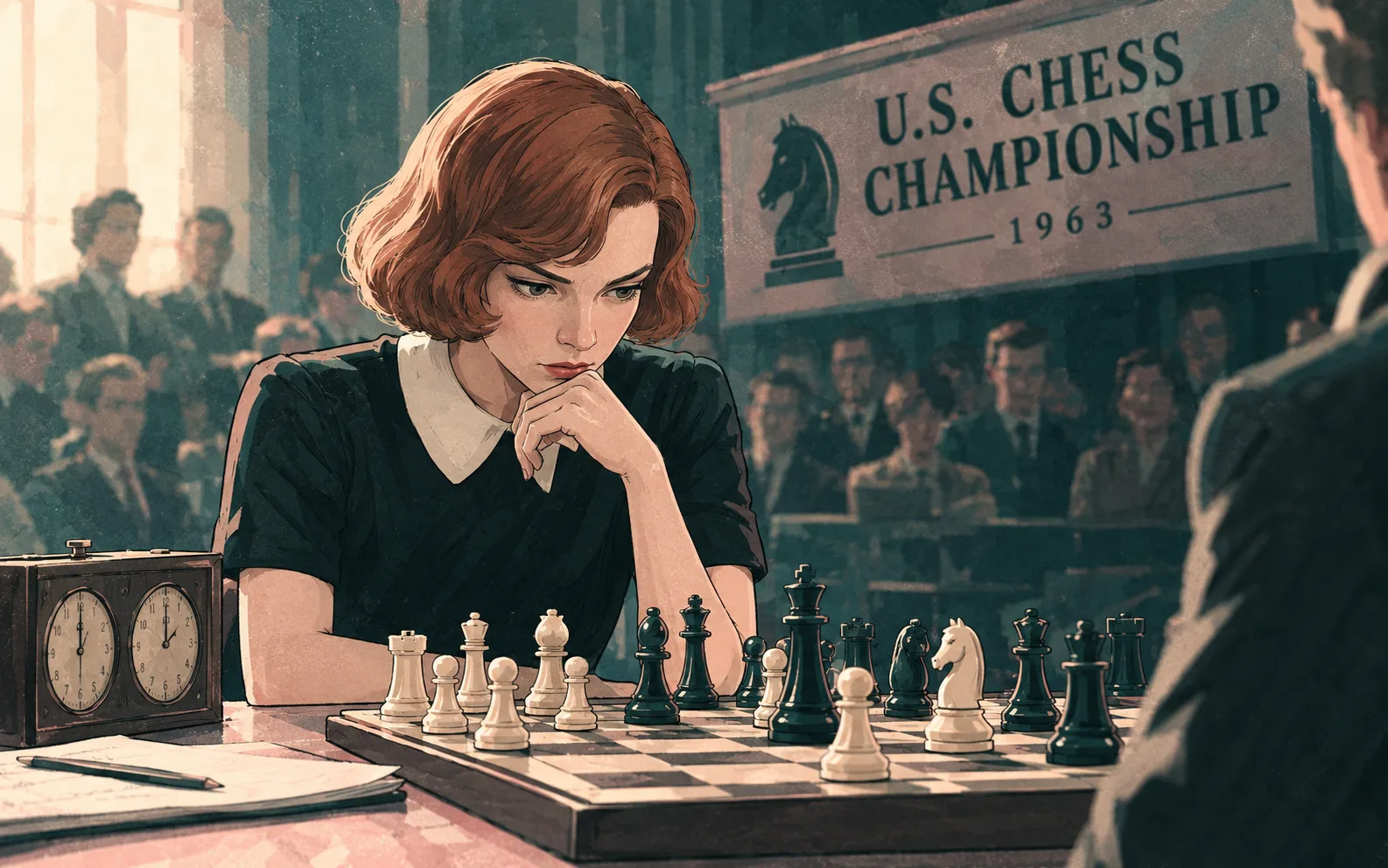
In short: The Queen’s Gambit (Netflix, 2020) is fiction, but almost every game in it is adapted from a real game by real players. Garry Kasparov and chess coach Bruce Pandolfini advised the production, and the show reuses positions and whole games from history, sometimes improving them at the critical moment to make Beth’s victory work. This guide maps the games, explains the ones that matter most move by move, and gives you the PGNs so you can replay them on AntChess.
Spoiler warning: this article describes the plot and results of all seven episodes.
The big picture
Seven episodes, dozens of games. Most are shown only in glimpses: a position on a board, a few moves, a clock, a face. The production team prepared several hundred chess positions for the script. Kasparov developed the critical moments, such as the finale, which is built on a real 1993 game between Vassily Ivanchuk and Patrick Wolff.
Two honest notes before we start:
- The show is not always a perfect record. The director has said the display board sometimes does not match exactly because of editing. Fans reconstructing the games from the screen have to make educated guesses, so the move lists you find online can differ slightly.
- Sources disagree on a few details, for example the year of the game used for Beth’s last opponent before Borgov (1988 or 1998). I flag these where they come up.
Quick map: every game and its source
| Episode | Scene | Based on (real game) | Notes |
|---|---|---|---|
| 1 | Beth loses to Mr. Shaibel | Scholar’s Mate pattern | Beth loses in four moves |
| 1 | Beth’s first win over Mr. Shaibel | Greco vs NN, 1620 | Giuoco Piano |
| 1 | Beth vs Mr. Ganz | Réti vs Tartakower, Vienna 1910 | Queen sacrifice, mate in three |
| 2 | Kentucky Championship vs Beltik | Nezhmetdinov vs Kasparian, 1955 | Caro-Kann; real game lasts 47 moves |
| 3 | Benny shows a Caro-Kann variation | Mieses vs Reshevsky, 1935 | Position only |
| 3 | US Open vs Benny Watts | Najdorf Sicilian | Source game not identified in my sources |
| 4 | Beth wins in Mexico City | Fischer vs Larsen, 1958 | Beth plays 29.d7 instead of 29.Bxf6 |
| 4 | Beth vs Diedrich | Bernstein vs Capablanca, 1914 | Final moves not shown |
| 4 | Beth vs Girev | Jakovenko vs Stellwagen, 2007 | Real game was a draw; Beth wins with 40.h5 |
| 4 | Beth loses to Borgov (Mexico City) | Stein vs Matanovic, 1965 | A slight variation |
| 5 | Beth vs Benny, blitz games | Nikolic vs Ivanchuk 2004; Kramnik vs Morozevich 2007; Baramidze vs Graf 2005 | Four blitz games, Benny wins all |
| 6 | Blitz simul vs Benny and friends | The Opera Game (Morphy, 1858) | Beth plays Morphy’s moves |
| 6 | Paris round | Averbakh vs Tolush, 1953 | |
| 6 | Beth loses to Borgov (Paris) | Probably Megaranto vs Dominguez, 2007 | Najdorf Sicilian |
| 7 | Beth vs Laev | Topalov vs Kasparov, 1995 | |
| 7 | Beth vs a Moscow opponent | Sax vs Korchnoi, 1986 | |
| 7 | Beth vs Hellstrom | Kasparov vs Huebner, 1985 | |
| 7 | Beth vs Luchenko | Petrosian vs Akopian (1988 per Chessgames; 1998 per Wikipedia) | Beth deviates and wins |
| 7 | Beth vs Borgov (the final) | Ivanchuk vs Wolff, Biel 1993 | Beth plays 37.Ne6 |
The sections below give full move-by-move treatment to the four games with verified PGNs. For the other games, see the “Where to find the rest” section at the end.
Episode 1: Openings
Game 1: Mr. Shaibel’s Scholar’s Mate
The scene: Nine-year-old Beth, who has only watched the janitor play, insists on a game. Mr. Shaibel uses a trap that catches most beginners, and Beth loses in four moves.
The opening: The Scholar’s Mate attacks the weakest square in Black’s camp, f7, which at the start of the game is defended only by the king.
[Event "Orphanage basement (pattern game)"]
[Site "Methuen Home (fictional)"]
[Date "1957.??.??"]
[White "Shaibel, William"]
[Black "Harmon, Elizabeth"]
[Result "1-0"]

1. e4 e5 2. Bc4 Nc6 3. Qh5 Nf6 4. Qxf7# 1-0
What happened:
- 1.e4 e5 2.Bc4: the white bishop points straight at f7.
- 3.Qh5: the queen joins the attack and also threatens the e5 pawn. Now f7 is attacked twice and defended once.
- 3…Nf6??: the decisive mistake. The knight attacks the queen, which feels natural, but it does not stop the mate. The correct defence was 3…g6 or 3…Qe7.
- 4.Qxf7#: the queen takes the pawn with checkmate, protected by the bishop.
Why it matters: This is the first lesson in the whole series: attack the weakest square and never ignore the opponent’s threat. Beth does not repeat the mistake.
Interactive game analysis loads here.
Note: I am giving the standard Scholar’s Mate pattern. The scene shows the idea, but the exact order of Black’s moves on screen may differ slightly.
Game 2: Beth vs Mr. Ganz (Réti vs Tartakower, 1910)
The scene: After beating Mr. Shaibel, Beth plays the high-school chess teacher, Mr. Ganz. She announces “that’s mate in three”, and it is a queen sacrifice.
The real game: In 1910 in Vienna, the young Richard Réti beat Savielly Tartakower in a famous miniature. The show recreates the finish.
[Event "Vienna"]
[Site "Vienna AUT"]
[Date "1910.??.??"]
[White "Reti, Richard"]
[Black "Tartakower, Savielly"]
[Result "1-0"]

1. e4 c6 2. d4 d5 3. Nc3 dxe4 4. Nxe4 Nf6 5. Qd3 e5 6. dxe5 Qa5+ 7. Bd2 Qxe5
8. O-O-O Nxe4 9. Qd8+ Kxd8 10. Bg5+ Kc7 11. Bd8# 1-0
What happened:
- 1.e4 c6 2.d4 d5: a Caro-Kann Defence (a solid opening, important in this series).
- 5.Qd3 e5: Black grabs space in the centre with a pawn thrust.
- 6.dxe5 Qa5+ 7.Bd2 Qxe5: Black wins back the pawn. White has a lead in development, and White’s king will go to the queenside.
- 8.O-O-O: White castles queenside, which puts the rook on the open d-file.
- 8…Nxe4??: the decisive mistake. It looks like it wins a piece, but White has a brilliant reply. My Stockfish check shows the position was roughly +1.4 for White before this move and a forced mate in 3 after it. The engine prefers 8…Be7.
- 9.Qd8+!!: the queen sacrifice. The black king must take it: after 9…Kxd8 it has no choice.
- 10.Bg5+: this is a double check. The bishop gives check and moving it opens the d-file, so the rook on d1 gives check too. In double check the king must move.
- 10…Kc7 11.Bd8#: the bishop lands on d8 and it is checkmate.
What to learn: A queen sacrifice is worth it if it forces mate. Look for forcing moves (checks and captures) first.
Try it: Load the PGN into the AntChess analysis board and find a better move than 8…Nxe4.
Interactive game analysis loads here.
Episode 2: Exchanges
Game 3: Beth vs Beltik (Nezhmetdinov vs Kasparian, 1955)
The scene: In the final of the Kentucky State Championship, Beth faces the reigning champion, Harry Beltik. He arrives late and tries to unsettle her. They play the Caro-Kann.
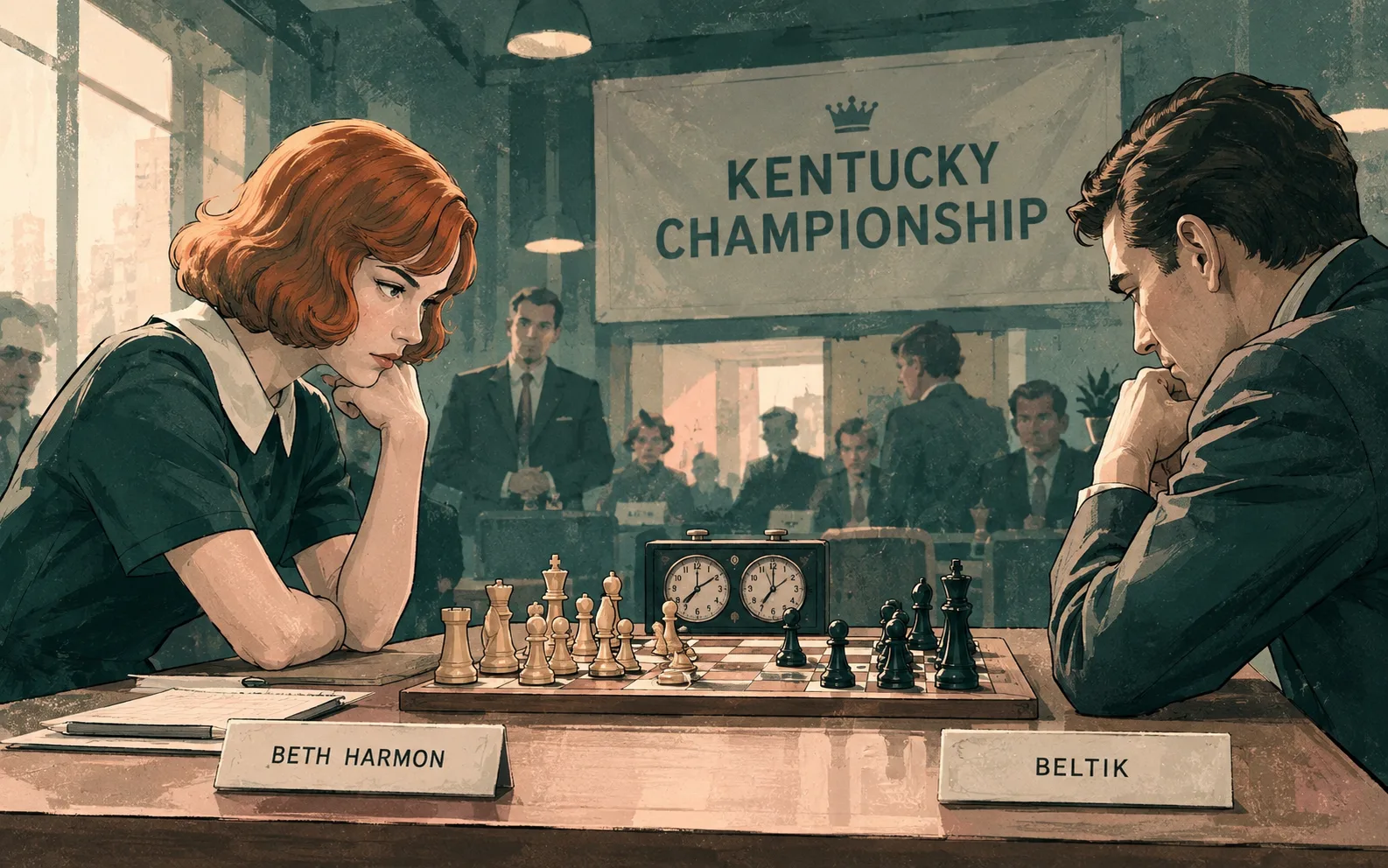
The real game: According to Chess.com and the Chessgames collection of the series’ games, the show reproduces a 1955 game between Rashid Nezhmetdinov, famous as an attacking genius, and Genrikh Kasparian, played in Riga in a team championship. The real game lasted 47 moves. In the series Beltik resigns after about move 41 (a sacrifice on g6 with the queen is listed as the key idea).
What I can and cannot give you here: Chess databases block automatic access, so I could not retrieve a verified PGN for this game, and I will not invent one from memory. Download it from Chessgames (game ID 1102189) and paste it into the AntChess analysis board. If you send me the PGN, I will check it and write the full move-by-move section.
Interesting detail: In episode 3, Benny Watts mentions this game, which he says he saw in Life magazine, and tells Beth she lost her advantage by castling. A commenter on Chessgames points out this comment is odd, since White castles early in the real game. Beth then sets up the position after 29…b6 and finds a better move on move 30. It’s a fun reminder that the show invents some of its chess dialogue.
Episode 4: Middle Game
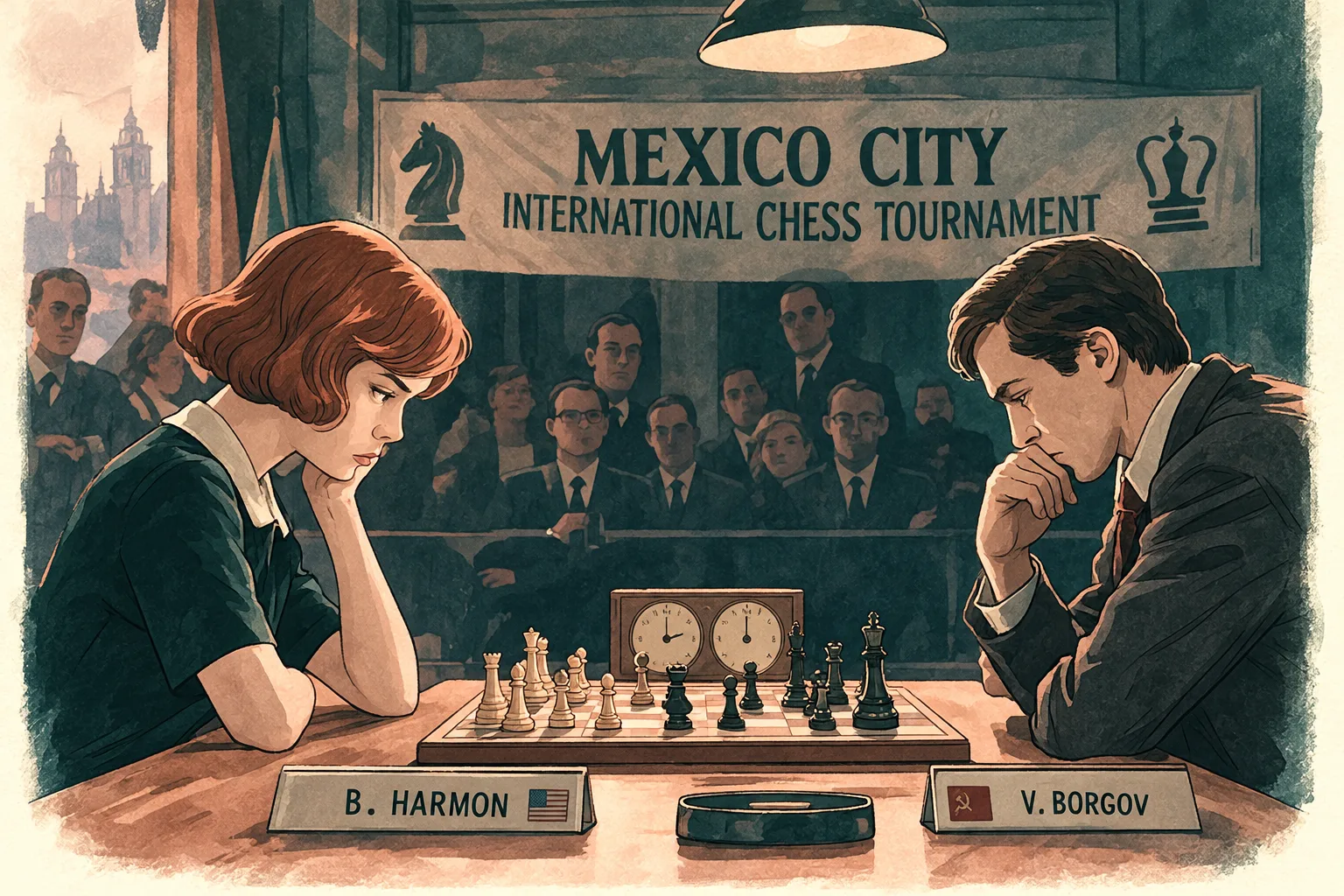
Game 4: Beth vs Girev (Jakovenko vs Stellwagen, 2007)
The scene: In Mexico City, 13-year-old Soviet prodigy Georgi Girev plays Beth in a long game that has to be adjourned. Beth wins after the adjournment, and Girev concedes with the words “I resign the old-fashioned way.”
The real game: In real life, Jakovenko vs Stellwagen (2007) was a 73-move draw, a Sicilian Taimanov. The show lets Beth find a winning improvement, 40.h5.
Source: Chessgames game ID 1444671. I could not verify the PGN, so I’m not printing it here.
Game 5: Beth vs Borgov in Mexico City (Stein vs Matanovic, 1965)
The scene: Beth meets world champion Vasily Borgov for the first time and loses, after he surprises her with an unexpected opening.
The real game: a slight variation of a 1965 game between the Soviet grandmaster Leonid Stein and Aleksandar Matanovic. The details are not retrievable from my sources.
Other Mexico City games
- Beth’s win over a player named Diedrich reconstructs Bernstein vs Capablanca, 1914 (a Queen’s Gambit Declined). The show only displays moves up to about 19…dxc4, not the stunning finish.
- Another win reproduces a game between Fischer and Larsen from 1958. Beth plays 29.d7 instead of Fischer’s 29.Bxf6, a slightly different (also winning) path that is less precise than Fischer’s forced mate.
Episode 5: Fork
The blitz games with Benny Watts
At a bar before the US Championship final, Benny challenges Beth to four blitz games. He wins all of them. According to Chess.com, the games are based on:
- Nikolic vs Ivanchuk, 2004: Benny wins by forking Beth’s queen and king.
- Kramnik vs Morozevich, 2007: Benny builds up pressure and forces Beth to resign.
- Baramidze vs Graf, 2005: Benny gains material and a passive position for Beth.
- The fourth game ends with a deflection of Beth’s rook leading to checkmate.
The lesson of the scene: Beth is clearly a better player at normal time controls, but speed chess exposes a gap. The next day she beats him in the final of the US Championship, but we never see that game.
Episode 6: Adjournment
Game 6: The Opera Game, replayed by Beth
The scene: During training in New York, Beth proposes a blitz simultaneous against Benny and his friends. She wins and, as Chess.com notes, she replays Paul Morphy’s famous Opera Game.
The real game: In 1858, in Paris, the American Paul Morphy beat the Duke of Brunswick and Count Isouard, who were consulting together, while the three watched an opera in a theatre box.
[Event "Casual game"]
[Site "Paris FRA"]
[Date "1858.??.??"]
[White "Morphy, Paul"]
[Black "Duke of Brunswick and Count Isouard"]
[Result "1-0"]

1. e4 e5 2. Nf3 d6 3. d4 Bg4 4. dxe5 Bxf3 5. Qxf3 dxe5 6. Bc4 Nf6 7. Qb3 Qe7
8. Nc3 c6 9. Bg5 b5 10. Nxb5 cxb5 11. Bxb5+ Nbd7 12. O-O-O Rd8 13. Rxd7 Rxd7
14. Rd1 Qe6 15. Bxd7+ Nxd7 16. Qb8+ Nxb8 17. Rd8# 1-0
What happened:
- 1.e4 e5 2.Nf3 d6 3.d4 Bg4: Black pins the knight on f3 against the queen.
- 4.dxe5 Bxf3 5.Qxf3 dxe5: pieces are exchanged. White’s queen now eyes f7.
- 6.Bc4: White attacks f7 again. Black’s best defence is awkward.
- 7.Qb3 Qe7: White attacks both b7 and f7 with the queen. Black defends f7 but leaves b7 weak.
- 8.Nc3 c6 9.Bg5 b5?: Black counterattacks, but walks into a sacrifice. My engine check puts White about +3.4 after this move.
- 10.Nxb5!: White sacrifices a knight to open lines. After 10…cxb5 11.Bxb5+, Black’s knight must block.
- 12.O-O-O: White castles into a rook on the open d-file and pins the knight on d7. Every White piece is now in play.
- 13.Rxd7 Rxd7 14.Rd1: a rook sacrifice, then the second rook pins the d7 knight against the king.
- 15.Bxd7+ Nxd7 16.Qb8+!!: the queen sacrifice. Black must take it.
- 16…Nxb8 17.Rd8#: checkmate with a rook, with Black’s own pieces blocking the escape squares.
Why it matters: The Opera Game is the classic lesson in development: Morphy brought out all of his pieces and attacked while Black’s king was stuck in the centre. When Beth replays it, the show connects her to chess history, but also to a tradition of beautiful attacking chess.
Interactive game analysis loads here.
Beth’s loss in Paris (Megaranto vs Dominguez, 2007)
In the final of the Paris tournament, Borgov plays a Najdorf Sicilian. Chess.com says the game is probably adapted from a 2007 game between Susanto Megaranto and Leinier Dominguez Perez. The previous night’s bender catches up with Beth, and she loses again, which sends her back home in despair.
Episode 7: End Game
Beth’s Moscow games
In Moscow, Beth is at her best, and the show uses famous games:
- Laev: a reproduction of a game with Topalov and Kasparov from 1995 (the commentator says “27 moves” while Chess.com counts 28).
- A Moscow opponent: Sax vs Korchnoi, 1986.
- Hellstrom: Kasparov vs Huebner, 1985.
- Luchenko: Petrosian vs Akopian. Chessgames dates the game 1988, while Wikipedia’s text says 1998, so treat the year as uncertain. The real game was a draw, and in the show Beth deviates after the adjournment, winning with the move 39…h5.
Game 7: The final, Harmon vs Borgov (based on Ivanchuk vs Wolff, Biel 1993)
The scene: The last game of the series. Beth plays White against the world champion and opens with the Queen’s Gambit, the opening that gives the series its name. Borgov accepts the pawn. The game is adjourned, Borgov offers a draw, and Beth refuses. The next day she wins.
The real game: Garry Kasparov selected and modified a game played on 16 July 1993 in Biel, Switzerland, between the Ukrainian grandmaster Vassily Ivanchuk and the American grandmaster Patrick Wolff. In the real game, Ivanchuk played 37.g4 and the game was drawn after 72 moves. In the series, Beth plays 37.Ne6, and the game continues differently.
Another small difference: in real life, the game was not adjourned after move 36. That was a TV invention to give Beth a night to think.
Here is the full game as shown on screen. Moves 1 to 36 follow the real game. The rest is the series’ version, as reconstructed by chess fans. (The game headers are invented, since the show never gives names or dates. The fictional result 1-0 and the final resignation are from the show.)
[Event "Moscow Invitational (fictional)"]
[Site "Moscow (fictional)"]
[Date "1968.??.??"]
[White "Harmon, Elizabeth"]
[Black "Borgov, Vasily"]
[Result "1-0"]

1. d4 d5 2. c4 dxc4 3. e4 Nc6 4. Be3 Nf6 5. Nc3 e5 6. d5 Ne7 7. Bxc4 Ng6
8. f3 Bd6 9. Qd2 Bd7 10. Nge2 a6 11. Bb3 b5 12. a4 O-O 13. O-O Qe7
14. Rac1 Nh5 15. g3 h6 16. Bc2 Rab8 17. axb5 axb5 18. Ra1 Ra8 19. Bd3 Bb4
20. Rxa8 Rxa8 21. Qc2 Bc5 22. Nd1 Bd6 23. Nf2 Nhf4 24. Rc1 Qg5 25. Kh1 Qh5
26. Ng1 Nxd3 27. Nxd3 f5 28. Nc5 Bc8 29. Rf1 Ne7 30. Qd3 fxe4 31. fxe4 Qg6
32. Kg2 Kh7 33. Nf3 Ng8 34. Nh4 Qg4 35. Nf5 Nf6 36. h3 Qg6 37. Ne6 Ra4
38. b3 Rxe4 39. Nxd6 Bxe6 40. dxe6 cxd6 41. e7 d5 42. Bc5 Qe8 43. Qf3 Qc6
44. b4 Qe8 45. Qf5+ Kh8 46. Qxf6 gxf6 47. Rxf6 Qh5 48. Rf8+ Kg7 49. e8=Q Re2+
50. Kf1 Qxh3+ 51. Kxe2 Qg2+ 52. Rf2 Qe4+ 53. Kd2 1-0
The story of the game, in stages
Moves 1 to 12: a Queen’s Gambit Accepted.
- 1.d4 d5 2.c4 dxc4: the gambit is accepted: Black takes the pawn.
- 3.e4 Nc6 4.Be3 Nf6 5.Nc3 e5 6.d5 Ne7: White builds a big centre of pawns and Black counters. This is a rich, strategic fight.
- 7.Bxc4 Ng6 8.f3 Bd6 9.Qd2 Bd7 10.Nge2 a6 11.Bb3 b5 12.a4: both sides develop, and White attacks on the queenside with the a-pawn.
Moves 13 to 30: manoeuvring. Both players castle, rooks are traded, and each side tries to find the best squares for its knights and bishops. This is the long, slow middle part of a world-class game, where one inaccuracy matters.
Moves 31 to 36: tension builds. Pieces cluster around the king on g7 and h7, and Borgov seals his move (36…Qg6) before the adjournment.
Move 37: the moment of improvement. In the real game, Ivanchuk played 37.g4. In the series, Beth finds 37.Ne6!, offering her knight to open lines against the black king and bishop. My Stockfish check rates 37.Ne6 as roughly equal (0.0), so it is a good practical try, not a forced win. (A Chessgames commenter running a longer engine analysis also found 37.g4 and 37.Ne6 close in value.)
Moves 38 to 41: the pawn. After 37…Ra4 38.b3 Rxe4 39.Nxd6 Bxe6 40.dxe6 cxd6, Black wins material, but White’s pawn on e6 is now dangerous. 41.e7 is the push, and Borgov replies 41…d5.
Move 42: Bc5. In the show, this is the moment when Beth stares at the ceiling, visualising the game without pills. 42.Bc5 blocks the bishop’s diagonal and prepares the final attack. The engine sees the position as balanced here, so this is a strong practical move rather than a forced win.
The decisive move: 44…Qe8??
The game turns on Borgov’s 44th move. After 43.Qf3 Qc6 44.b4, the engine sees the position as slightly better for White (about +0.5). Then Borgov plays 44…Qe8??, and the evaluation jumps to about +3.1 for White. The alternative 44…Kg8 was best according to engine analysis.
Why is this a blunder? Because it allows a spectacular queen sacrifice:
- 45.Qf5+ Kh8: the queen gives check, and Black’s king is forced to the corner.
- 46.Qxf6!! gxf6 47.Rxf6: White sacrifices the queen to remove the knight that protects the king and the pawn on e7.
- 47…Qh5 48.Rf8+ Kg7 49.e8=Q: the pawn queens with the rook on f8 supporting it.
- 49…Re2+ 50.Kf1 Qxh3+ 51.Kxe2 Qg2+ 52.Rf2 Qe4+ 53.Kd2: Black runs out of checks. At this point White has a rook and a bishop extra, and Black can no longer give any useful checks.
Borgov sees that he is lost and concedes the game, telling Beth, in effect, that it is hers to take.
Was Beth’s win realistic?
Mostly, with an important caveat. The game is real up to move 36 and the improvement 37.Ne6 is reasonable. But a world champion would be very unlikely to blunder with 44…Qe8, and engines suggest the position was balanced before that move. So the TV win relies on a human error, which is what happens in real chess too. As the comment from one chess player put it, the show is realistic about the chess and generous with the drama.
What to learn:
- Prepare for the unexpected move. Beth’s improvement works because Borgov has not prepared for it.
- Visualise. The show makes a big deal of Beth calculating without a board.
- Never refuse a win, and never offer a draw you do not want. Beth rejects the draw because she believes she can win. Be sure of your reasons if you do the same.
Try it: On the AntChess analysis board, go to move 44 and play 44…Kg8 instead of 44…Qe8. Does the engine agree it is the better move? Then try defending as Borgov. Can you hold the draw?
Interactive game analysis loads here.
Where to find the rest
I could not retrieve verified PGNs for the following games, because the chess databases do not allow automatic access. Here are the Chessgames IDs from the collection “The chess games of Beth Harmon” so you can download each one:
| Show game | Real game | Chessgames ID |
|---|---|---|
| Beth’s first win vs Shaibel | Greco vs NN, 1620 | 1271125 |
| Beth vs Beltik | Nezhmetdinov vs Kasparian, 1955 | 1102189 |
| Mexico City win | Fischer vs Larsen, 1958 | 1008373 |
| Beth vs Diedrich | Bernstein vs Capablanca, 1914 | 1261680 |
| Beth vs Girev | Jakovenko vs Stellwagen, 2007 | 1444671 |
| Beth vs Luchenko | Petrosian vs Akopian | 1974291 |
| Beth vs Borgov (final) | Ivanchuk vs Wolff, 1993 | 1060353 |
(Use the URL https://www.chessgames.com/perl/chessgame?gid= followed by the ID. The PGN download link is on each page.)
Tip: if you send me any of these PGNs, I will verify them with an engine and write the full move-by-move article for that game, in the same style as the ones above.
Frequently asked questions
Are the chess games in The Queen’s Gambit real? Most are adapted from real games by real players. Kasparov and Pandolfini selected them, and in some cases changed the critical moves to make Beth win.
Which real game is the final against Borgov based on? Ivanchuk vs Wolff, from the Biel Interzonal in July 1993. In the real game, Ivanchuk played 37.g4 and the game ended in a draw. In the series, Beth plays 37.Ne6.
Is Beth Harmon a real person? No. She is a fictional character created by the novelist Walter Tevis. Her path is often compared to that of Bobby Fischer.
Is Vasily Borgov real? No, he is fictional.
What opening is the series named after? The Queen’s Gambit: 1.d4 d5 2.c4.
Can I play these games online? Yes. Paste any PGN from this page into the AntChess analysis board.
Your turn
- Load the final game into the AntChess analysis board and step through it. Watch the evaluation bar around move 44.
- Replay the Opera Game and see if you can find a better defence than 9…b5 for Black.
- In Réti vs Tartakower, try defending as Black from move 8. Can you survive?
- Paste your own game and see which of Beth’s lessons you broke.
Analyze these games on AntChess →
AntChess is an independent chess-study project and is not affiliated with Netflix or the makers of The Queen’s Gambit.
Sources
- Chess.com: “The Queen’s Gambit: Every Chess Position” (Pedro Pinhata) and “The Queen’s Gambit On Netflix”
- Chessgames.com: the collection “The chess games of Beth Harmon” and the game page for Ivanchuk vs Wolff, 1993
- Wikipedia: The Queen’s Gambit (miniseries) and Patrick Wolff
- Lichess study “Beth Harmon (Queen’s Gambit)” (search-result excerpts only; the site blocks automated access)
- Fan wiki reconstruction of the final game’s PGN, cross-checked against the Chessgames, blog and Lichess excerpts for moves 1 to 13 and 37 onward