
One casual game in London, 1851. A bishop, two rooks and a queen thrown away. Checkmate delivered by three small pieces. Nearly two centuries later, it is still the most celebrated attack in chess history.
The city, the summer, the tournament
London, summer of 1851. The city is packed with visitors for Prince Albert’s Great Exhibition, a showcase of the industrial age. Inside its shadow, the English master Howard Staunton organises something no one has tried before: the first international chess tournament.
Players travel from across Europe. Among them is Adolf Anderssen, a mathematics teacher from Breslau, who plays chess in his spare time and is about to become the most talked-about player alive. Also there is Lionel Kieseritzky, born in the Baltic region and living in Paris, where he gives chess lessons and edits the chess magazine La Régence. He is a respected analyst, known for his deep study of gambit openings.
The two meet early. Anderssen knocks Kieseritzky out of the tournament in round one. Anderssen goes on to win the whole event, and many begin calling him the strongest player in the world.
But the game that made both men famous is not one of the tournament games at all.
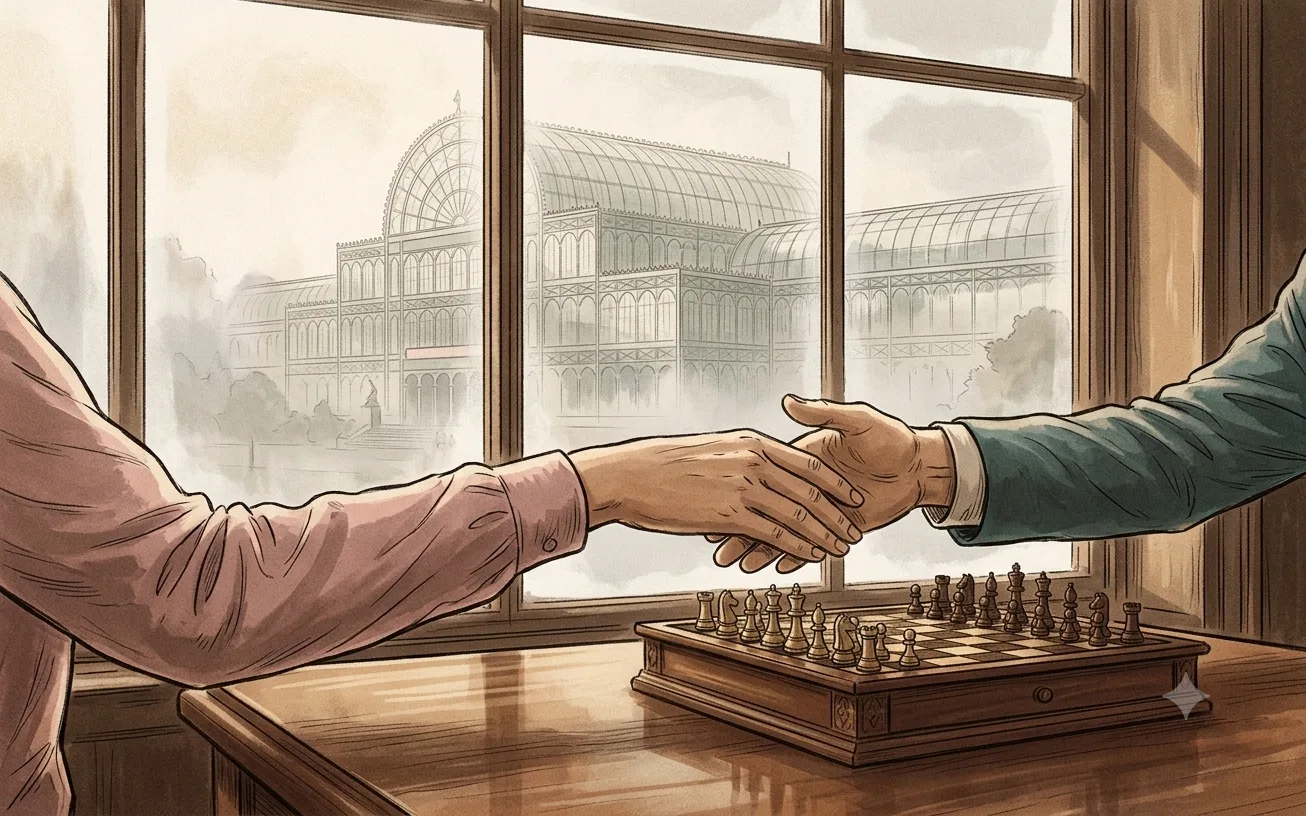
An offhand game that changed history
On 21 June 1851, according to Kieseritzky’s own report in La Régence, the two men sat down for a friendly game during a break in the tournament. Most accounts place it at Simpson’s Divan on the Strand, the coffee house where London’s chess players gathered. (Historians such as Edward Winter have asked what firm evidence exists for the venue, so it is best described as the traditional account.)
There were no prizes and no clocks like today’s. It was a casual game between two rivals. It became the most reprinted game in chess history.
Act one: a gambit and a counter-gambit
Anderssen, playing White, opens with the King’s Gambit, the most romantic opening of the era: White offers a pawn to open lines and attack quickly.
1. e4 e5 2. f4 exf4 3. Bc4
Kieseritzky accepts the pawn and immediately checks the king:
3… Qh4+ 4. Kf1
White can no longer castle. In modern chess, that would worry most players. Anderssen does not care. He is playing for the attack.
Kieseritzky then counters with a bold pawn offer of his own:
4… b5
This is known as the Bryan Counter-gambit, an idea Kieseritzky had studied deeply. The point is to grab White’s bishop or drag it away from its strong diagonal. Anderssen takes the pawn:
5. Bxb5 Nf6 6. Nf3 Qh6 7. d3 Nh5 8. Nh4 Qg5 9. Nf5 c6
Look at what has happened. Both sides have ignored the standard rules of development. White’s king cannot castle. Black’s queen has been chased around the board. Everything is in motion, and nobody is playing safe.
Act two: attack, and give up a bishop
10. g4 Nf6 11. Rg1!
Now comes a surprise. Anderssen ignores the threat to his bishop and pushes his attack on the kingside. Black takes the bishop:
11… cxb5
Anderssen has given up a piece. It will not be the last.
12. h4 Qg6 13. h5 Qg5 14. Qf3 Ng8 15. Bxf4 Qf6 16. Nc3 Bc5 17. Nd5
White’s pieces flood the centre and kingside. Black’s queen takes a pawn on b2, hoping to win material and hit the rook in the corner:
17… Qxb2
Most players in Anderssen’s position would defend. Instead, he plays one of the most famous moves in chess:
The move that shocked the room
18. Bd6!?
Interactive position after 18.Bd6 loads here.
With this bishop move, Anderssen ignores the danger to both of his rooks. The bishop on d6 is attacked by nothing, but it cuts across Black’s position and prepares a mating attack on the black king. The move offers both rooks.
Kieseritzky takes the rook on g1:
18… Bxg1
Then Anderssen plays a quiet pawn move, not a capture and not a check:
19. e5!
The pawn push closes lines and keeps White’s threats alive. It is the kind of move that looks obvious only after you have seen it.
Black takes the second rook, with check:
19… Qxa1+ 20. Ke2 Na6
Black now has a queen, two rooks, a bishop and a knight to White’s few remaining pieces. On the board, White has given up a huge amount of material. But Black’s king is stuck in the centre, and Black’s pieces are far from the action.
Act three: the queen goes too
21. Nxg7+ Kd8
Now the knight captures a pawn with check and forces the black king to step aside. Then comes the moment the game is named for:
22. Qf6+!!
Anderssen sacrifices his queen. Black’s knight has to take it:
22… Nxf6
Interactive position after 22...Nxf6 loads here.
And then:
23. Be7#
.webp)
Checkmate. White’s bishop delivers the final blow, supported by the two knights. Anderssen has given up a bishop, both rooks, and his queen, and won with three minor pieces.
(Some accounts say Kieseritzky resigned before the last moves were actually played, and that Anderssen announced the mating sequence. Either way, the game is recorded in the form above.)
Why “Immortal”?
The game did not get its famous name right away. Four years later, in 1855, the Austrian chess writer Ernst Falkbeer published an analysis in the Wiener Schach-Zeitung and called it “die unsterbliche Partie”: the Immortal Game. The name stuck.
Kieseritzky himself did not treat it as an embarrassing loss. He recorded the game and published it in La Régence in July 1851, and the story goes that he telegraphed the moves to his chess club in Paris. He died in Paris on 18 May 1853, only two years after the game.
Anderssen later played another famous sacrificial masterpiece, the Evergreen Game, which shows that the Immortal Game was no accident. He was a genuine artist of the attack.
Is it a perfect game?
Here is the honest answer: no. Modern chess engines find improvements for Black, and some annotators mark Anderssen’s 18th move as dubious. If Kieseritzky had defended more accurately, the game might have ended differently.
But that misses the point. The Immortal Game is not remembered because it was flawless. It is remembered because it shows something chess players love: the courage to give up everything for an idea, and the beauty of a plan that comes together.
What it can teach you today
- Material is not everything. Pieces are worth more when they are active. Black’s extra pieces were stuck far from the king.
- Speed matters. Anderssen used the initiative to create threats every move, so Black never had time to organise a defence.
- King safety decides games. Kieseritzky’s king was stranded in the middle. Once the lines opened, there was nowhere to hide.
- Don’t copy it blindly. Modern engines punish reckless sacrifices. Study the ideas, but calculate carefully in your own games.
Legacy
The Immortal Game has lived on in surprising ways. The Italian town of Marostica has replayed it with live actors dressed as chess pieces since 1923. The position after move 20 appeared on a 1984 postage stamp from Suriname. And the final part of the game is said to have inspired the chess scene in the 1982 film Blade Runner.
Play it. Analyze it. Find what Anderssen missed.
Now it’s your turn. Load the full game into the AntChess analysis board and:
- Step through each move and see the engine’s evaluation.
- Find the moment where Black could have defended better.
- Try a different move and see what happens.
Use the interactive board below to replay the game, compare engine lines, and explore your own ideas.
.webp)
Interactive game analysis loads here.