
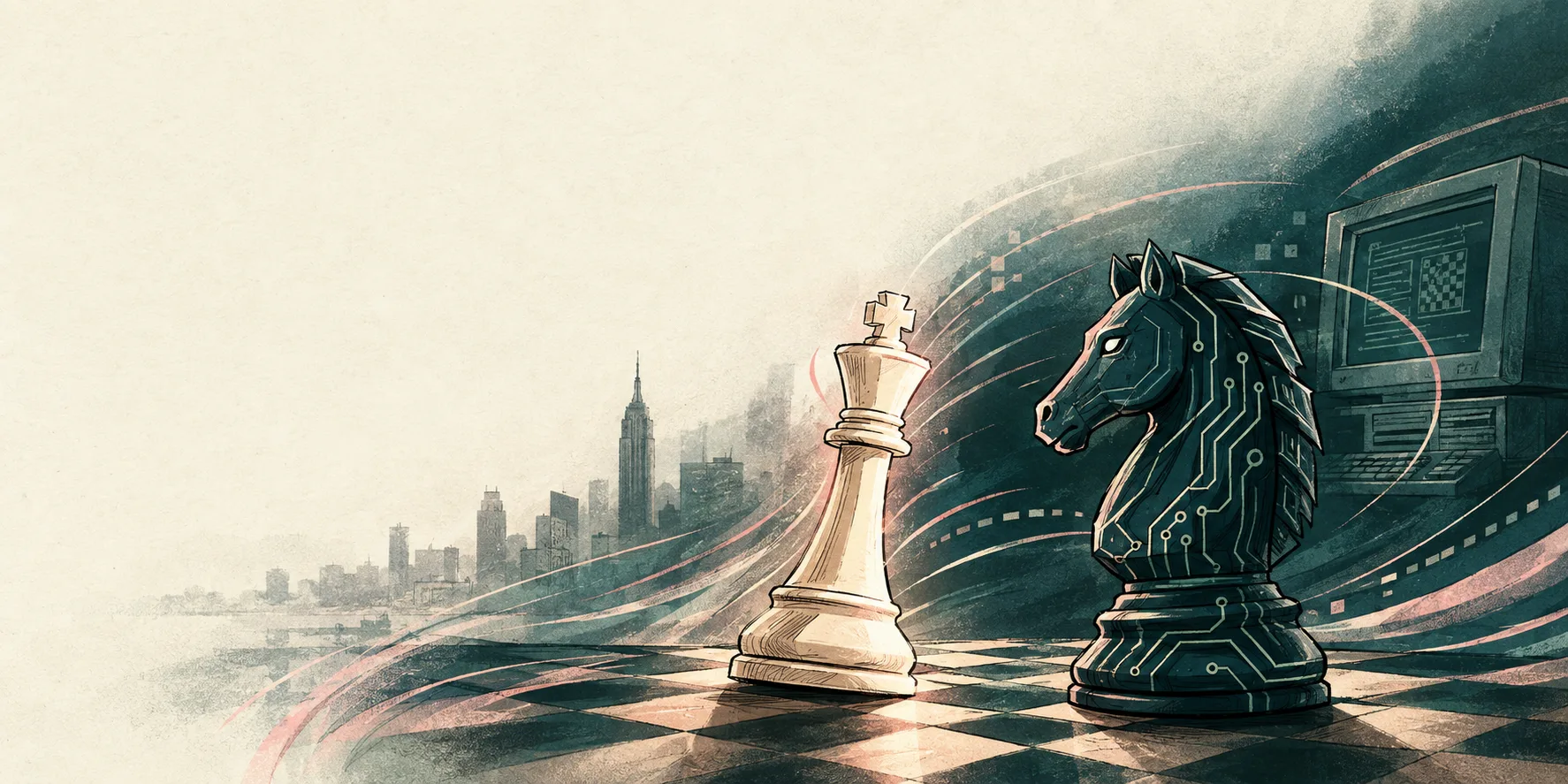
New York, 11 May 1997. The reigning world champion sits down for the final game of a match against a machine, and is gone in barely over an hour.
The champion at the top
By the mid-1990s, Garry Kasparov was more than a champion. He was chess itself. He had held the world title since 1985, and no one had come close to taking it from him for long.
Then IBM came calling with a computer.
In February 1996, Kasparov played the first match against Deep Blue in Philadelphia. The machine won the very first game, the first time a computer had beaten a reigning world champion under normal tournament time controls. But Kasparov steadied himself and won the match 4–2. Humanity, it seemed, was safe.
IBM went away, upgraded the machine, and asked for a rematch.
The rematch
The 1997 match took place at the Equitable Center in New York between 3 and 11 May. A stronger Deep Blue, sometimes nicknamed “Deeper Blue,” faced a Kasparov who was still confident.
He won Game 1 in fine style. Then came Game 2, and the mood changed. Deep Blue played in a way that felt strangely human: patient, positional, not at all what people expected from a calculator. Kasparov resigned, and some analysts later thought the position might have been holdable. He left the room shaken, and afterwards accused IBM’s team of getting outside help. Games 3, 4 and 5 were all draws.
That left everything hanging on Game 6. The score stood level at 2.5 each. Whoever won would take the match.
Sunday, 3 p.m.
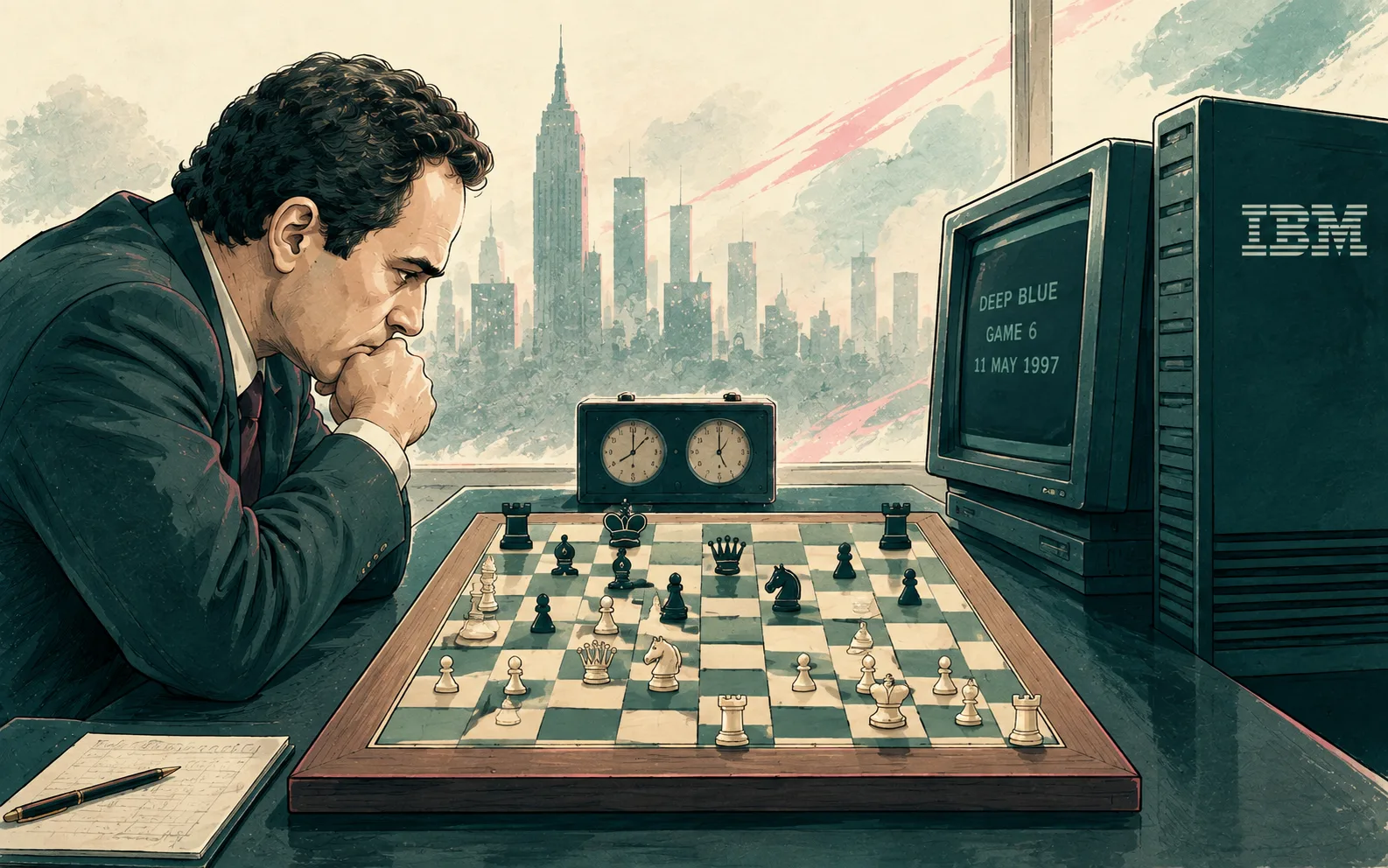
Game 6 started at 3:00 p.m. on 11 May 1997. Kasparov had the black pieces and chose the Caro-Kann Defence, a solid opening that was not his usual choice against human opponents. The game followed the Steinitz Variation (ECO B17).
Here is the complete game. Step through it here, or choose Analyze the full game to open the full AntChess analysis board.
Interactive game analysis loads here.
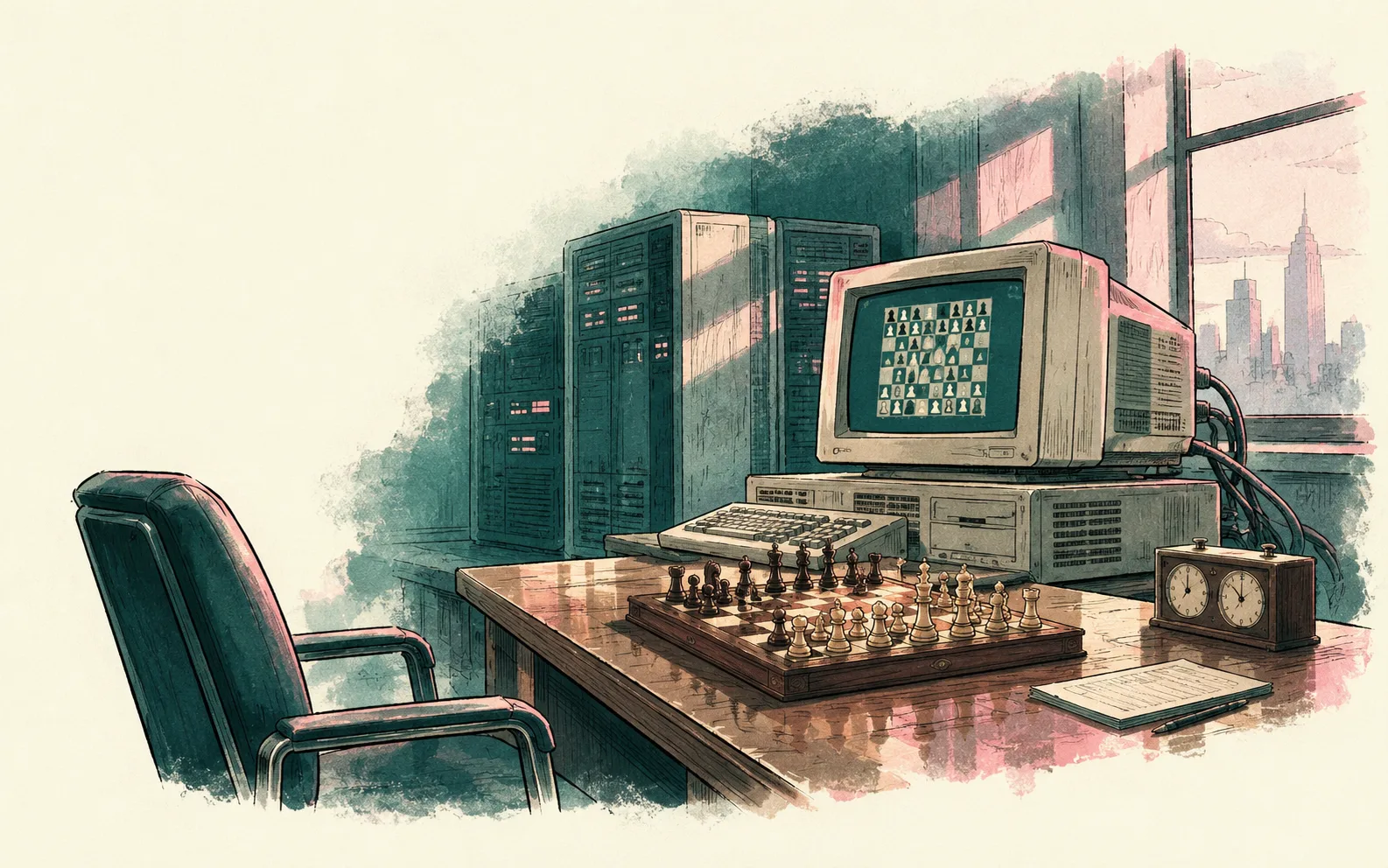
Act one: a normal opening, until it isn’t
For six moves, everything looks routine. White plays 1.e4, Black answers with the Caro-Kann, and both sides develop pieces along well-known lines. Then comes the move everyone still argues about.
7…h6
On move 7, Kasparov pushed a pawn: 7…h6. It attacks White’s knight on g5, and it looks perfectly natural. The trouble is timing. In the usual version of this variation, Black first develops the bishop with 7…Bd6 and only then plays …h6. Kasparov had seen exactly that sequence in his own games, including earlier games of his against Kamsky (1994) and Epishin (1995).
By pushing the pawn a move early, Black allowed a sacrifice that was already known in opening theory. The board below starts just before Black’s choice; try both moves and compare the resulting positions. The choice has been explained in different ways: it may have been a move-order mix-up, or an attempt to steer the computer into unfamiliar play. Those are interpretations, not a settled account of Kasparov’s intent.
Interactive position after 7.N1f3 loads here.
8.Nxe6!
White’s knight captured a pawn on e6, offering itself as a sacrifice:
8. Nxe6! Qe7
Interactive position after 8.Nxe6 loads here.
If Black takes the knight with the f-pawn, White’s bishop will come to g6 with check and Black’s king will be dragged out into the open. Kasparov chose to attack the knight with his queen, and after 9.O-O fxe6 the same idea came anyway.
So why did Kasparov play 7…h6 at all? Two very different explanations have been offered:
- Mixed-up moves. Some commentators believe he simply confused his opening move order, playing …h6 a move too early. Wikipedia’s account of the game suggests exactly this.
- A deliberate trap. Feng-Hsiung Hsu, Deep Blue’s chief architect, suggested it could have been an “anti-computer” gamble: Kasparov may have hoped Deep Blue would either retreat the knight and lose time, or sacrifice it and struggle. But according to accounts, the sacrifice was already in Deep Blue’s opening preparation, so it didn’t have to work it out for itself.
The available accounts do not settle which explanation best describes Kasparov’s intent.
Act two: the king who couldn’t castle
Here is what the sacrifice achieves:
9. O-O fxe6 10. Bg6+ Kd8
White’s bishop lands on g6 with check. Black’s king has to step to d8, and it can never castle again. The king is now in the middle of the board with its own pieces tangled around it.
11. Bf4 b5 12. a4 Bb7 13. Re1 Nd5 14. Bg3 Kc8
Black tries to run to the queenside. White calmly brings a rook to the e-file, and pieces line up against the e6 pawn and the black king.
15. axb5 cxb5 16. Qd3 Bc6
The queen comes to d3, eyeing the b5 pawn and the whole diagonal towards Black’s king.
Act three: the final blow
17. Bf5! exf5
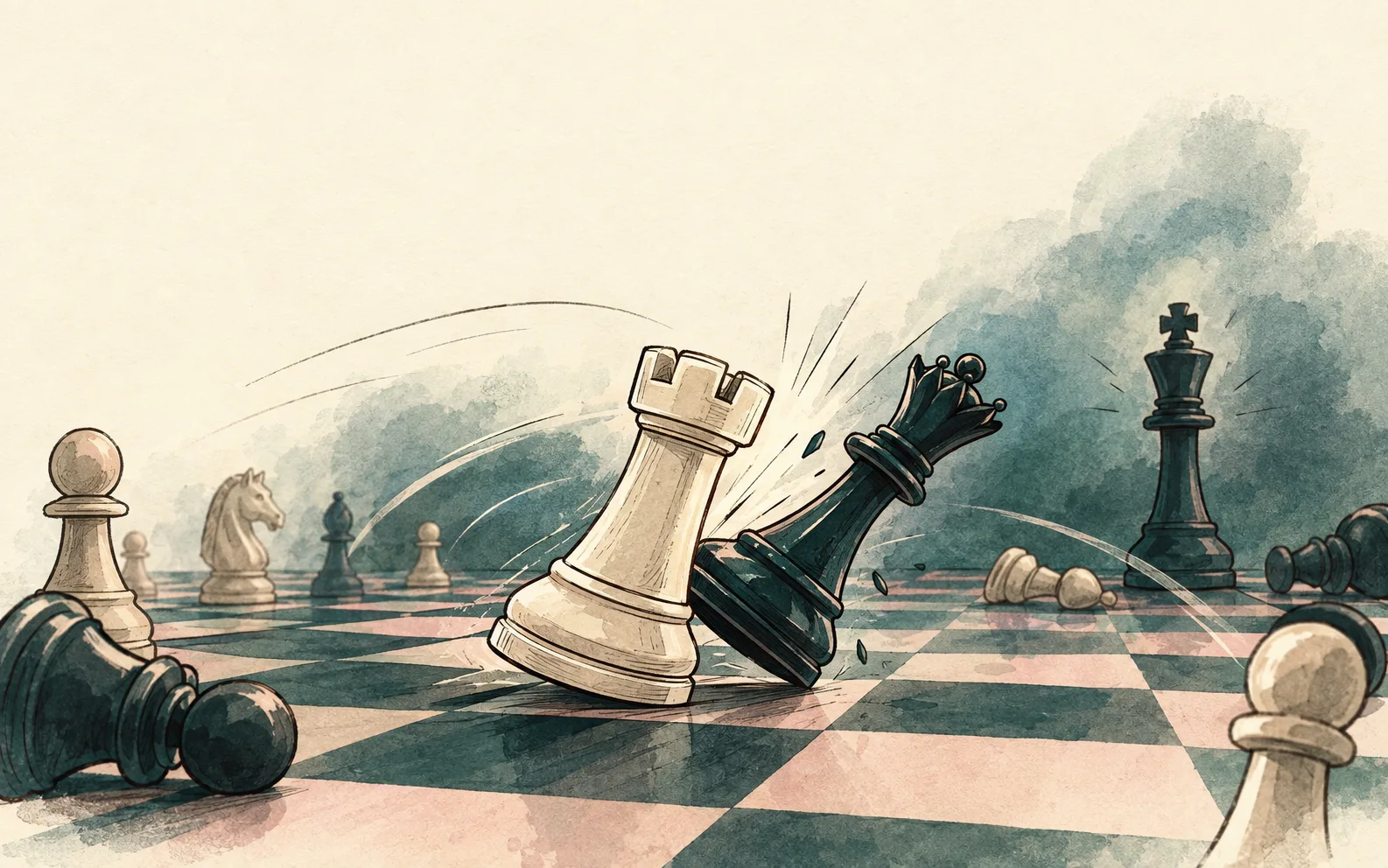
Deep Blue now offers its bishop. If Black declines, the pressure only grows. Kasparov took it.
18. Rxe7 Bxe7
Interactive position after 18...Bxe7 loads here.
The rook captures Black’s queen on e7. Black recaptures with a bishop, so on paper Black now has more material: two rooks, two bishops and two knights against White’s queen, rook, bishop and knight.
But the numbers lie. Black’s pieces are scattered, the king stuck on c8 has no shelter, and White’s queen is running free.
19. c4
The pawn attacks the knight on d5 and keeps every line open for White’s queen. Kasparov looked at the position and resigned.
The whole game had lasted 19 moves and barely more than an hour.
Was the position really lost?
Here opinion divides, and it’s worth being honest about it.
Some accounts describe Kasparov’s collapse as psychological: a tired man, down to the last game, who had already lost faith. Others point out that Black’s position, though very difficult, wasn’t necessarily beyond all defence. Modern engines running on ordinary computers can find the 8.Nxe6 sacrifice even without opening books, which says how much computer chess has advanced since 1997. It’s also true that the resulting position is extremely hard for a human to defend.
There’s a lesson in that. What computers did brilliantly in 1997 was calculate concrete lines without getting frightened. What Kasparov’s position asked of him was to survive an attack that looked unpleasant and wasn’t yet fatal. It’s exactly the kind of situation where human nerves can fail, and where a machine has none to lose.
Aftermath: the accusation
After the game, Kasparov accused IBM of cheating, alleging that human grandmasters had helped Deep Blue during the match. IBM denied the allegation. Kasparov asked for another match; IBM declined and retired Deep Blue.
The final result, Deep Blue 3½ – Kasparov 2½, made it the first time a computer had beaten a reigning world champion in a six-game match under standard tournament conditions. The match became a milestone in computer chess and a widely watched public test of machine calculation against a world champion.
What this game can teach you
- Opening move order matters. One move too early, and a known trap becomes playable for your opponent. Learn why moves come in a certain order, not just the moves.
- Don’t fear sacrifices you can calculate. When a piece is offered, check what your king will look like afterwards, not just what you win.
- A king in the middle is a target. Once Black lost the right to castle, everything White did was aimed at it.
- Material isn’t everything. After 18…Bxe7 Black has more pieces, but White’s queen and open lines mattered more.
- Resignation is a decision. Whether Kasparov should have played on is still debated. In your own games, don’t resign just because a position looks unpleasant.
Play it, analyze it, improve it
Now try it yourself:
- Step through the replay board above. Watch the evaluation bar after 7…h6, and compare it with the position before.
- At move 7, play 7…Bd6 instead, the move theory recommends, and see how the game changes.
- Look at move 17. Can you find a defence that keeps Black alive longer?
- Try playing the position after 10.Bg6+ from Black’s side against a friend or engine.
Return to the interactive game replay →
Sources
- IBM, “Deep Blue” — background on the 1996 match and the 1997 rematch result.
- ChessBase, “25 years ago: Deep Blue beats Kasparov” — historical context for both matches and Game 6.
- Game 6 move score and annotations — move-by-move record and discussion of the disputed opening choice.