In short: Chess is played on an 8x8 board by two players, White and Black, who take turns moving one piece at a time. Each piece moves in its own way. The goal is to checkmate the opponent’s king, meaning the king is attacked and cannot escape. This guide covers every piece, every special move and every way a game can end, and each rule comes with a short game you can replay on the AntChess analysis board.
How to use this guide: each example is a small PGN (a text record of a game). Replay them in the interactive boards below, or download the complete piece-movement games.
Contents
- The board and the starting position
- The goal of the game
- How each piece moves (king, queen, rook, bishop, knight, pawn)
- Special moves: castling, en passant, promotion
- Check, checkmate and pins
- Every way a game can end in a draw
- Winning on time, resigning and other results
- Tournament rules: touch-move, clocks and illegal moves
- How to read chess notation (SAN, PGN and FEN)
- Old rules and old pieces: how chess changed
- New pieces and variants
- Frequently asked questions
- Fun exercise: the Rules Gauntlet
1. The board and the starting position
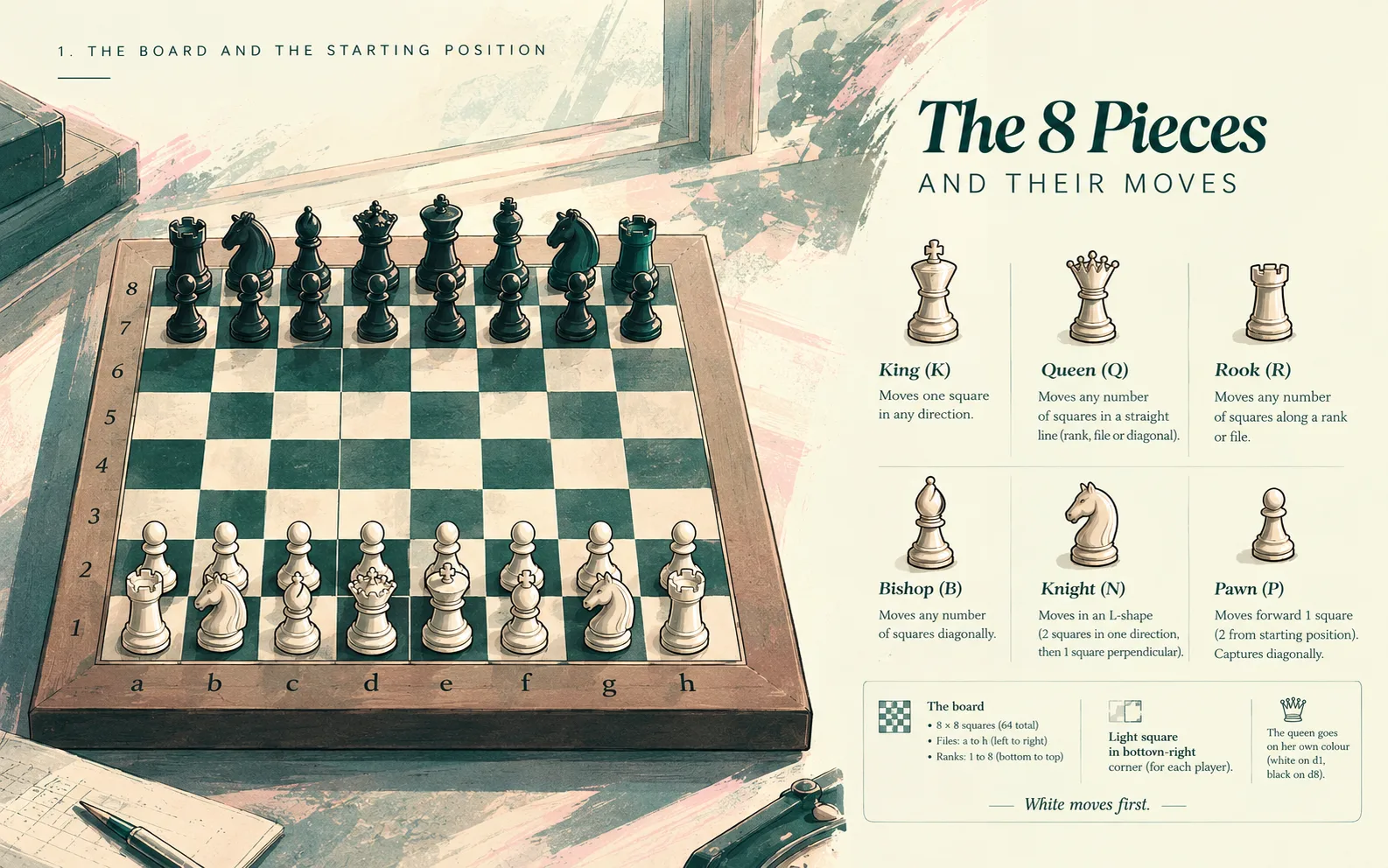
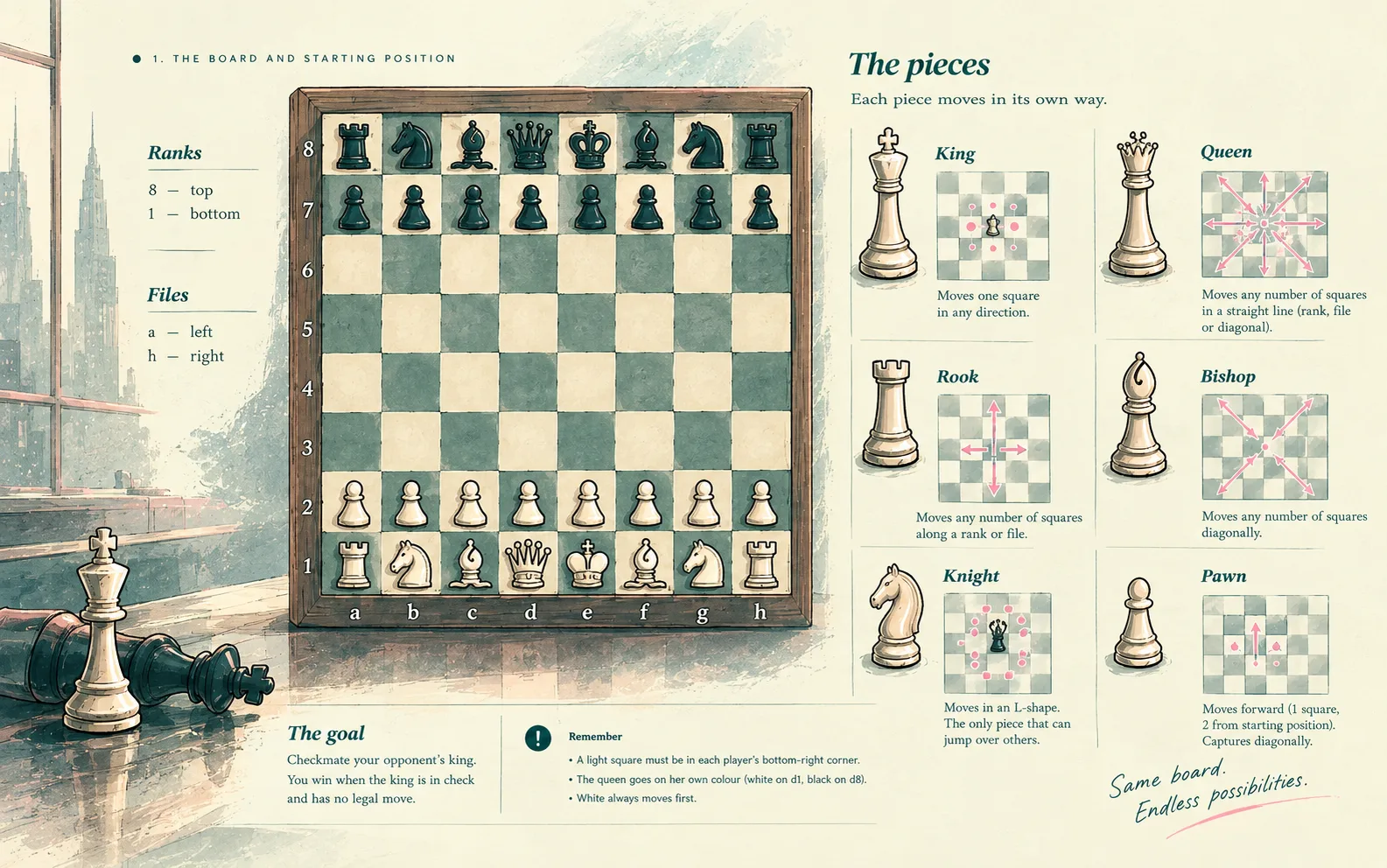
The chessboard has 64 squares in 8 rows and 8 columns, alternating light and dark. The columns are called files (a to h, left to right from White’s side). The rows are called ranks (1 to 8, from White’s side to Black’s).
Two rules of setup trip up beginners:
- A light square must be in each player’s bottom-right corner. If the board is the wrong way round, turn it.
- The queen goes on her own colour. The white queen starts on a light square (d1) and the black queen on a dark square (d8).
Each side starts with 16 pieces: one king, one queen, two rooks, two bishops, two knights and eight pawns.
8  r n b q k b n r     (Black)
7  p p p p p p p p
6  . . . . . . . .
5  . . . . . . . .
4  . . . . . . . .
3  . . . . . . . .
2  P P P P P P P P
1  R N B Q K B N R     (White)
   a b c d e f g h
The standard starting position written in FEN (see section 9) is:
rnbqkbnr/pppppppp/8/8/8/8/PPPPPPPP/RNBQKBNR w KQkq - 0 1
White always moves first. Players alternate turns, and you may not pass. Moving is compulsory, which matters later when we reach stalemate.
2. The goal of the game
You win by checkmating the opponent’s king. A king is in check when it is attacked by an enemy piece. It is checkmate when the king is in check and the player has no legal move that gets out of check. Nobody ever actually captures the king. The game ends one move earlier.
A game can also end by resignation, by running out of time, or in a draw. Those are covered in sections 6 and 7.
3. How each piece moves
A few rules apply to every piece:
- You capture by moving onto a square occupied by an enemy piece, which removes it from the board. (Pawns capture differently, see below.)
- You can never capture your own piece, and you cannot land on a square one of your own pieces occupies.
- Only the knight can jump over other pieces. Every other piece is blocked by anything in its path. (Castling is a special case, see section 4.)
- You may never make a move that leaves your own king in check.
The King (K)
Moves one square in any direction: forward, backward, sideways or diagonally.
Extra rules:
- A king can never move to a square that an enemy piece attacks.
- Two kings can never stand on adjacent squares.
- The king can take part in castling (section 4).
Example game: the king walks. Both kings step forward one square at a time.
[Event "King: one square at a time"]
1. e4 e5 2. Ke2 Ke7 3. Kd3 Kd6 *
In this game, White’s king goes e1, e2, d3 and Black’s king goes e8, e7, d6. Each move is exactly one square.
The Queen (Q)
Moves any number of squares in a straight line: along a rank, a file or a diagonal. She combines the rook and the bishop, and she is the most powerful piece.
Extra rules:
- She cannot jump over pieces.
- She captures by landing on an enemy piece.
Example game: the queen strikes. This is the famous Scholar’s Mate: the white queen slides diagonally from d1 to h5, then captures on f7 with checkmate.
[Event "Queen: diagonal slide and capture"]
1. e4 e5 2. Qh5 Nc6 3. Bc4 Nf6 4. Qxf7# 1-0
The black knight’s 3…Nf6 attacks the queen but fails to defend f7, so 4.Qxf7# ends the game. (The # symbol means checkmate.)
Interactive game analysis loads here.
The Rook ®
Moves any number of squares along a rank or a file (horizontally or vertically). It never moves diagonally.
Extra rules:
- It cannot jump.
- It takes part in castling (section 4).
- Rooks are strongest on open files and on the 7th rank.
Example game: the rook lifts. Both sides advance the h-pawn to free the rook, then slide it along the third and sixth ranks.
[Event "Rook: ranks and files"]
1. h4 h5 2. Rh3 Rh6 3. Rg3 Rg6 *
The Bishop (B)
Moves any number of squares diagonally.
Extra rules:
- A bishop always stays on the colour of the square it started on. That is why each side has a light-squared bishop and a dark-squared bishop.
- It cannot jump.
- Two bishops working together (the bishop pair) are often considered a strength, but that is strategy, not a rule.
Example game: bishop captures with check. White’s bishop takes the pawn on f7 with check, and the black king recaptures.
[Event "Bishop: diagonal move and capture"]
1. e4 e5 2. Bc4 Bc5 3. Bxf7+ Kxf7 *
(This is a lesson in a different way: a bishop worth about three pawns just gave itself up for one. Just because you can capture does not mean you should.)
The Knight (N)
Moves in an “L” shape: two squares in one direction (horizontal or vertical), then one square at a right angle. It is the only piece that jumps over other pieces.
Extra rules:
- It always moves to a square of the opposite colour from the one it starts on.
- From the centre it can reach up to eight squares; from a corner only two.
- It captures by landing on an enemy piece.
Example game: knights jump and capture. The knights leap out from behind the pawns, then trade on d5.
[Event "Knight: L-shaped jumps"]
1. Nf3 Nf6 2. Nc3 Nc6 3. Nd5 Nxd5 *
Notice that White’s very first move, 1.Nf3, leaps out from behind the wall of pawns, something no other piece can do.
The Pawn (P)
Pawns are the most unusual pieces because they move one way and capture another, and they can never go backward.
Moving:
- A pawn moves one square forward if that square is empty.
- On its first move only, a pawn may move two squares forward, if both squares are empty.
- A pawn cannot capture straight ahead. If a piece is directly in front of it, the pawn is blocked.
Capturing:
- A pawn captures one square diagonally forward, never straight.
Special pawn moves: en passant and promotion (section 4).
Example game: double step and diagonal capture. White’s pawn jumps two squares on move 1, then captures diagonally on move 2.
[Event "Pawn: double step and capture"]
1. e4 d5 2. exd5 Qxd5 3. Nc3 *
Here exd5 means “the pawn on the e-file captures on d5”. Notice that the queen recapturing then walks into an attack by the knight.
Quick comparison
| Piece | Movement | Can jump? | Typical value (convention) |
|---|---|---|---|
| King | 1 square, any direction | No | Priceless |
| Queen | Any distance, straight or diagonal | No | 9 |
| Rook | Any distance, rank or file | No | 5 |
| Bishop | Any distance, diagonal | No | 3 |
| Knight | “L” shape | Yes | 3 |
| Pawn | Forward 1 (or 2 on first move); captures diagonally | No | 1 |
The values in the last column are a teaching convention, not part of the rules.
4. Special moves
Castling
Castling is the only move in which two pieces move at once: the king and a rook. It protects the king and brings the rook into play. You castle by moving the king two squares toward a rook, then placing that rook on the square the king crossed.
- Kingside castling (short, written O-O): king goes e1 to g1, rook goes h1 to f1.
- Queenside castling (long, written O-O-O): king goes e1 to c1, rook goes a1 to d1.
You may castle only if all of these are true:
- Neither the king nor that rook has moved earlier in the game.
- All squares between the king and the rook are empty.
- The king is not currently in check.
- The king does not pass through a square that an enemy piece attacks.
- The king does not land on an attacked square.
Note what castling does not require: it is allowed even if the rook is attacked, and queenside castling is allowed when the b-file square next to the rook is attacked (only the squares the king crosses matter).
Example game: both sides castle kingside.
[Event "Castling kingside"]
1. e4 e5 2. Nf3 Nc6 3. Bc4 Bc5 4. O-O Nf6 5. d3 O-O *
Example game: both sides castle queenside.
[Event "Castling queenside"]
1. d4 d5 2. Nc3 Nc6 3. Bf4 Bf5 4. Qd2 Qd7 5. O-O-O O-O-O *
When castling is illegal. In the position below, Black’s bishop on c4 attacks the square f1, which stops kingside castling, because the king would pass through an attacked square. (You can load this position as a FEN into the board and test it: the king’s legal moves are d1, d2 and f2.)
[Event "Why White cannot castle"]
[SetUp "1"]
[FEN "4k3/8/8/8/2b5/8/8/4K2R w K - 0 1"]
1. Kd2 *
En passant
En passant is French for “in passing”. It is the special pawn capture people most often think is a mistake.
It works like this:
- Your pawn stands on its fifth rank (rank 5 for White, rank 4 for Black).
- An enemy pawn on an adjacent file makes its two-square first move, landing right beside your pawn.
- On your very next move only, you may capture that pawn as if it had moved only one square. Your pawn lands on the square the enemy pawn passed over.
If you do not capture immediately, the right disappears.
Example game: White’s pawn reaches e5, Black plays d7-d5 (jumping past d6), and White captures it “in passing”.
[Event "En passant"]
1. e4 a6 2. e5 d5 3. exd6 *
After 3.exd6, the black pawn on d5 is gone, even though White’s pawn did not land on d5. It landed on d6, the square the black pawn had crossed.
Promotion
When a pawn reaches the far end of the board (rank 8 for White, rank 1 for Black), it must become another piece: a queen, rook, bishop or knight (never a king or another pawn). The choice is yours. You may even have several queens at once.
Promoting to a queen is by far the most common choice, so it is written =Q. Choosing another piece is called underpromotion, and there are real reasons to do it (see below).
Example game: a pawn captures and promotes. White’s pawn marches by capturing and finally takes the rook on a8, becoming a queen.
[Event "Promotion with capture"]
1. e4 d5 2. exd5 c6 3. dxc6 Nf6 4. cxb7 Nbd7 5. bxa8=Q *
(This sequence is for demonstrating the rule. Black’s play is not serious.)
Why would anyone underpromote? Sometimes a queen would cause a stalemate (a draw), but a rook would not. Try this one yourself in the final exercise.
5. Check, checkmate and pins
Check
A king is in check when an enemy piece attacks it. A player in check must respond immediately. There are exactly three ways:
- Move the king to a safe square.
- Capture the checking piece.
- Block the line between the checking piece and the king (this works only against queens, rooks and bishops, not knights or pawns).
If none of these is possible, it is checkmate.
Escape by moving the king:
[Event "Escape check: king moves"]
1. e4 e5 2. Bc4 Nc6 3. Bxf7+ Ke7 *
Escape by capturing the checking piece: White’s queen takes on e5 with check, and Black’s knight captures it.
[Event "Escape check: capture"]
1. e4 e5 2. Qh5 Nc6 3. Qxe5+ Nxe5 *
Escape by blocking:
[Event "Escape check: block"]
1. e4 f5 2. Qh5+ g6 *
Double check
When two pieces give check at once, blocking or capturing cannot solve both. The king must move.
Checkmate
Example: Fool’s Mate, the shortest possible game. It needs Black to find the fastest mate against a carelessly played opening.
[Event "Fool's Mate"]
1. f3 e5 2. g4 Qh4# 0-1
White’s pawn moves (f3 and g4) open the diagonal to the white king, and the black queen delivers mate on move 2. Mate in two moves is the fastest game possible.
Pins
A pin is when a piece cannot move because doing so would expose a more valuable piece (or the king) behind it. If the piece is pinned against the king, moving it is illegal, because that would leave your king in check.
Example game: after 3.Bb5, the knight on c6 is pinned against the king on e8 as soon as Black moves the d-pawn out of the way.
[Event "A pinned knight"]
1. e4 e5 2. Nf3 Nc6 3. Bb5 d6 4. Bxc6+ bxc6 *
6. Every way a game can end in a draw
A draw means nobody wins. These are the draws recognised in the FIDE Laws of Chess (the international rulebook; the edition in force since January 2023 is used here).
| Draw | What happens | Automatic? |
|---|---|---|
| Stalemate | The player to move has no legal move and is not in check | Yes |
| Agreement | Both players agree to a draw | Yes (once agreed) |
| Threefold repetition | The same position appears for the third time | Needs a claim |
| Fivefold repetition | The same position appears five times | Automatic |
| Fifty-move rule | 50 moves by each side with no capture and no pawn move | Needs a claim |
| Seventy-five-move rule | 75 moves by each side with no capture and no pawn move | Automatic |
| Insufficient material / dead position | No sequence of legal moves can lead to checkmate | Yes |
Stalemate
Stalemate is one of the most surprising rules for beginners. If it is your turn, you are not in check, and you have no legal move, the game is a draw, not a win for the other side. Because moving is compulsory, a player who is hopelessly behind can sometimes escape this way.
The most famous stalemate trick is Sam Loyd’s 10-move game, in which White gives away almost everything and ends with a stalemate:
[Event "Stalemate: Sam Loyd's 10-move game"]
1. e3 a5 2. Qh5 Ra6 3. Qxa5 h5 4. h4 Rah6 5. Qxc7 f6 6. Qxd7+ Kf7
7. Qxb7 Qd3 8. Qxb8 Qh7 9. Qxc8 Kg6 10. Qe6 1/2-1/2
After 10.Qe6, Black’s king is not in check and none of Black’s pieces can move. It is stalemate, and the game is drawn.
Threefold and fivefold repetition
If the same position (same pieces, same squares, same player to move, same legal moves available) appears three times, the player to move may claim a draw. If it appears five times, the game is drawn automatically. The positions do not need to occur in a row.
Example game: both players shuffle their knights back and forth. After move 4, the starting position has appeared three times.
[Event "Threefold repetition"]
1. Nf3 Nf6 2. Ng1 Ng8 3. Nf3 Nf6 4. Ng1 Ng8 1/2-1/2
Perpetual check is a related idea: one player gives check again and again, and the other cannot escape, so the same position keeps returning.
The fifty-move and seventy-five-move rules
If 50 moves by each player (100 half-moves) pass with no pawn move and no capture, a player on the move may claim a draw. After 75 moves by each side, the game is drawn automatically, unless the 75th move delivers checkmate. These rules stop games from continuing forever.
Insufficient material
Some positions can never end in checkmate, even with the worst play. The standard examples are king versus king, king and bishop versus king, and king and knight versus king. In these the game is drawn at once.
[Event "Insufficient material: K vs K"]
[SetUp "1"]
[FEN "8/8/8/4k3/8/8/4K3/8 w - - 0 1"]
1. Kd2 Kd4 1/2-1/2
7. Winning on time, resigning and other results
- Checkmate: the standard win.
- Resignation: a player may give up at any time. This is the usual way games end among stronger players, who see the end coming.
- Time: in timed games, a player whose clock reaches zero loses, unless the opponent has no possible way to checkmate by any series of legal moves, in which case the game is drawn.
- Forfeit: a player who breaks serious tournament rules or does not show up can lose.
Results are written 1-0 (White wins), 0-1 (Black wins), 1/2-1/2 (draw) or * (game unfinished).
8. Tournament rules
In casual games these are often relaxed, but in tournaments they matter.
Touch-move. If you deliberately touch one of your own pieces, you must move that piece if it has a legal move. If you touch an enemy piece, you must capture it if you can. If you only want to straighten a piece, say “I adjust” (or “j’adoube”) before you touch it.
Completing a move. A move is final once you release the piece on a new square. A capture is complete once the captured piece is removed and your piece is placed.
Illegal moves. If a player completes an illegal move, the standard penalty in the 2023 FIDE Laws is time added to the opponent’s clock (two minutes on the first occasion). Check the rules of your own tournament, since details vary.
Clocks. Players press a clock after each move. Each player’s time counts down only while it is their turn.
Draw offers. You offer a draw after making your move, not before. The opponent can accept or decline.
Different rules apply in different places. Online sites and national federations (such as US Chess) have small differences from FIDE. In particular, online servers handle repetition and illegal moves in their own ways. When in doubt, read the rules for your event.
9. How to read chess notation
Algebraic notation (SAN)
Every square has a name: a file letter and a rank number (e4, g7, a1). Moves are recorded like this:
| Symbol | Meaning |
|---|---|
| K, Q, R, B, N | King, queen, rook, bishop, knight (pawns have no letter) |
| x | Capture (Nxe5 = knight captures on e5) |
| + | Check |
| # | Checkmate |
| O-O / O-O-O | Kingside / queenside castling |
| =Q | Promotion (e8=Q) |
| e.p. | En passant (optional note) |
PGN (Portable Game Notation)
PGN is the standard text format for whole games. It has tags in square brackets (event, players, date, result) and then the moves. Every example in this article is a mini-PGN. You can paste PGN into the AntChess analysis board, Chess.com, Lichess and nearly every other chess program.
FEN (Forsyth-Edwards Notation)
FEN describes one position, not a whole game. It has six parts: piece placement (rank 8 to rank 1, with numbers for empty squares), side to move, castling rights, en passant square, half-move clock (for the fifty-move rule) and move number.
rnbqkbnr/pppppppp/8/8/8/8/PPPPPPPP/RNBQKBNR w KQkq - 0 1
10. Old rules and old pieces: how chess changed
Chess was not always played this way. Its ancestors came from India and Persia, and the modern rules took shape in Europe over several centuries. The dates below are approximate, and historians disagree about some of them.
The ancestors: chaturanga and shatranj
Chess grew out of an Indian game called chaturanga (around the 6th century), which passed to Persia as shatranj and then to the Islamic world and Europe. In shatranj:
| Old piece | Modern descendant | How it moved |
|---|---|---|
| Shah | King | One square any direction (unchanged) |
| Ferz (vizier, “counsellor”) | Queen | One square diagonally only |
| Alfil (elephant) | Bishop | Jumped exactly two squares diagonally, leaping over a piece in between |
| Faras (horse) | Knight | L-shape (unchanged) |
| Rukh | Rook | Straight lines (unchanged) |
| Baidaq | Pawn | One square forward only, no double step, no en passant |
Because the ferz and alfil were so short-ranged, the game was slow. Some sources also describe unusual endings in shatranj, such as winning by stalemating the opponent, or by capturing every enemy piece except the king (“baring the king”), though accounts vary.
The great change, about 1475 to 1525
Around 1475, chess was reshaped in southern Europe. The weak ferz became the powerful queen (any distance in any straight line), and the alfil became the long-range bishop. The new game was faster and more tactical, and is sometimes called “queen’s chess” or “mad queen chess”.
At roughly the same time:
- Castling gradually appeared, and different regions had different versions for a long time.
- The pawn’s two-square first move was introduced, and with it en passant, to stop pawns from slipping past each other. Sources disagree on exact dates (some say the 15th century, others the 16th), and the rule was not universally standardised until much later.
- Stalemate was treated differently in different places. It was a win for one side, a loss for another, and eventually a draw, which became the standard rule only in the 19th century.
The modern rulebook
In the 19th and 20th centuries the rules were standardised, first through national clubs and then through FIDE, the international chess federation. Some changes you may not know about:
- Fivefold repetition and the seventy-five-move rule became automatic draws (the fivefold rule was introduced in 2014).
- The current FIDE Laws of Chess have been in force since 1 January 2023, with the Laws reviewed roughly every four years. FIDE has also discussed a rewrite of the Laws, so check the FIDE handbook for the latest version before you publish or rely on a detail in a tournament.
11. New pieces and variants
In official chess there are no new pieces: the six piece types have not changed in centuries. But there are famous variants.
- Chess960 (Fischer Random): introduced by Bobby Fischer in 1996. The back-rank pieces start in a random order (with some conditions, such as bishops on opposite colours and the king between the rooks), so memorised openings are useless. Castling still works, with its own rules for where the king and rook land.
- Capablanca Chess: a variant on a larger board (10 files by 8 ranks) with two extra pieces: the Archbishop (moves as a bishop plus a knight) and the Chancellor (moves as a rook plus a knight). It is traditionally attributed to the champion José Raúl Capablanca.
- Fairy chess pieces: problem composers invent many extra pieces, such as the nightrider (a knight that keeps repeating its jump in a straight line) and the amazon (queen plus knight). These are used in puzzles, not in normal games.
Each variant has its own rules, so always check them before you play.
12. Frequently asked questions
How do the pieces move in chess? The king moves one square in any direction. The queen moves any distance in straight lines. The rook moves along ranks and files. The bishop moves along diagonals. The knight moves in an L-shape and can jump. The pawn moves forward one square (two on its first move) and captures diagonally.
Can you castle out of check? No. You cannot castle while your king is in check, cannot castle through an attacked square and cannot land on one.
What is en passant? A special pawn capture. If an enemy pawn makes a two-square first move and lands beside your pawn on the fifth rank, you may capture it on your very next move as if it had moved one square.
What happens when a pawn reaches the end of the board? It must be promoted to a queen, rook, bishop or knight of the same colour.
What is the difference between stalemate and checkmate? In checkmate, the king is attacked and cannot escape, and the player loses. In stalemate, the player to move is not in check but has no legal move, and the game is a draw.
Can a king capture a piece? Yes, unless the piece is protected, since capturing a protected piece would put the king in check.
Who moves first? White.
How many moves does it take to checkmate? The fastest possible checkmate takes two moves each (Fool’s Mate, see section 5).
What is the touch-move rule? If you deliberately touch a piece, you must move it (if it has a legal move). To adjust a piece without moving it, say “I adjust” first.
Are the rules the same online? Mostly, with small differences in how sites handle repetition, illegal moves and time.
13. Fun exercise: the Rules Gauntlet
Time to test what you learned. The interactive board below contains all seven games. You can also download the Rules Gauntlet PGN. Choose a challenge from the game menu, try it on the board, then check your answer below.
Challenge 1: En passant. White has just seen Black play …d7-d5. Position (FEN): rnbqkbnr/1pp1pppp/p7/3pP3/8/8/PPPP1PPP/RNBQKBNR w KQkq d6 0 3. White to move. Find a capture that uses a special rule.
Challenge 2: Can White castle? Position (FEN): 4k3/8/8/8/2b5/8/8/4K2R w K - 0 1. Can White castle kingside? If not, which squares can the king go to?
Challenge 3: Promote wisely. Position (FEN): 8/k1P5/8/2K5/8/8/8/8 w - - 0 1. White’s pawn is about to promote. What happens if White promotes to a queen? Which piece should White promote to instead?
Challenge 4: Back-rank mate. Position (FEN): 6k1/5ppp/8/8/8/8/8/3R2K1 w - - 0 1. White to move. Mate in one.
Challenge 5: Mate in one for Black. After 1.f3 e5 2.g4, Black to move. Position (FEN): rnbqkbnr/pppp1ppp/8/4p3/6P1/5P2/PPPPP2P/RNBQKBNR b KQkq - 0 2.
Challenge 6: Which rule ends this game? Replay 1. Nf3 Nf6 2. Ng1 Ng8 3. Nf3 Nf6 4. Ng1 Ng8. What is the result, and why?
Challenge 7: Find the stalemate. Replay Sam Loyd’s 10-move game from section 6 and spot the exact move that ends it. Why is it a draw even though Black has more pieces?
Interactive game analysis loads here.
Answers (try first!)
- 3.exd6 (en passant). The pawn on e5 captures the pawn that just passed d6.
- No. Black’s bishop on c4 attacks f1, which the king would cross. The king’s legal moves are Kd1, Kd2 and Kf2.
- Promoting to a queen (c8=Q) is stalemate (a draw). Promoting to a rook (c8=R) keeps the win. This is a famous reason to underpromote.
- Rd8#. The rook lands on d8, and Black’s own pawns block the king’s escape.
- 2…Qh4#. Fool’s Mate.
- Draw by repetition. The same position has now occurred three times, so a player may claim a draw.
- 10.Qe6 is stalemate. Black is not in check, but none of Black’s pieces can move.
Where to go next
- Replay the Immortal Game and watch the rules in action.
- Learn about castling, en passant, stalemate and draws in more detail in the dedicated guides on this site.
- Import one of your own games and see how the engine marks your mistakes.